
LUNA LUNA, HELLER
TO HULL
ARTIST INTERVIEW
ARTIST INTERVIEW
Research
LUNA LUNA, HELLER
TO HULL
Interview with Steven Hull, conducted by MOSCW.
Links: https://nothingmomentspress.com/blind-date/

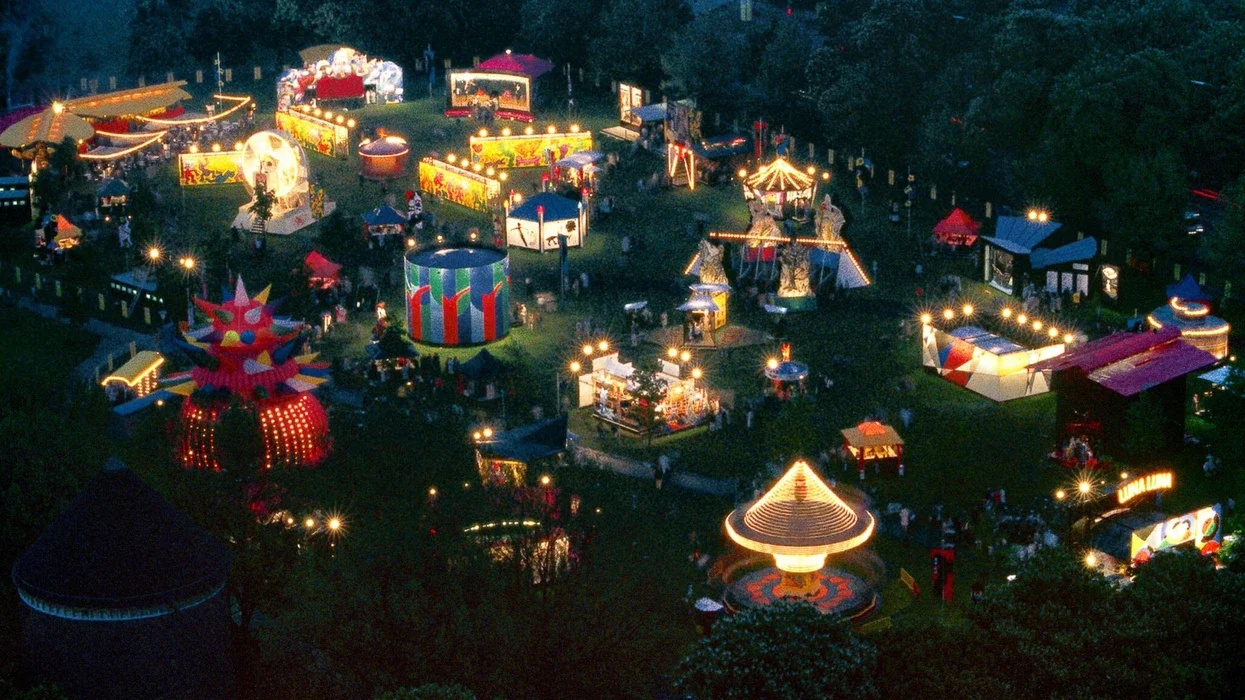
Sabina Sarnitz, Luna Luna: The Art Amusement Park, Hamburg, 1987. Courtesy of the Luna Luna Archive.
Research
Interview with Steven Hull, conducted by MOSCW.
Links: https://nothingmomentspress.com/blind-date/
FROM TOTAL ARTWORK
TO TOTAL MEMORY
“It feels like such a weird, strange time capsule of probably the most influential art thing of my life.” - Steven Hull, interview with MOSCW.
Few projects occupy a more paradoxical position in the history of postmodern exhibition-making than Luna Luna: The Art Amusement Park, conceived by the Austrian artist André Heller and installed in Hamburg in 1987. Bringing together more than thirty artists—including Jean-Michel Basquiat, Keith Haring, Roy Lichtenstein, Salvador Dalí and David Hockney—the project placed sculpture, architecture, performance and spectacle within the spatial logic of a functioning fairground. Yet despite the prominence of its participants, the park existed publicly for only two months before disappearing from view for more than three decades.
This brevity has left Luna Luna in an unusual relation to art history. A project of remarkable ambition, yet experienced by relatively few; a gathering of major artists, yet only lightly documented. Following its closure the installations were dismantled and transported to storage in the Texas desert, where they remained for decades. What had been conceived as a dynamic environment of movement and encounter entered a prolonged state of suspension.
The circumstances raise a larger question. What becomes of an artwork once the spatial conditions that organised its experience have vanished? Can an exhibition persist after the environment that sustained it dissolves? Or does the work continue indirectly—through memory, interpretation and the practices shaped by those who once encountered it?
Seen from this perspective, Luna Luna survives less as a physical site than as a historical afterimage. Its significance lies not only in the moment of its installation but in the conceptual possibilities it set in motion.
Heller conceived the project partly as a response to what he perceived as the cultural rigidity of the European art world in the 1980s. Rather than situating art exclusively within institutional space, he sought to recover the imaginative energies historically associated with popular spectacle. Artists were invited to produce works capable of, in his words, “tell[ing] stories… that will open your eyes in every way.”
The fairground therefore functioned not merely as a setting but as a method. Reflecting on the atmosphere of the park, Heller wrote:
“We encounter evil images and hauntings along with laughter and ridicule.”
Within this formulation the carnival assumes a distinctly dialectical role. Pleasure and disturbance coexist. Amusement becomes a framework through which the contradictions of late modernity—technology, industrialisation and psychic unease—are staged and made visible.
In this respect Luna Luna enters into dialogue with the long history of the Gesamtkunstwerk, or total artwork. In nineteenth-century theory, most famously in the writings of Richard Wagner, the term described the synthesis of artistic disciplines into a unified experiential form. During the twentieth century, however, this ideal was repeatedly reinterpreted. Rather than seeking seamless unity, modern and postmodern practices often foregrounded the tensions between artistic media.
Luna Luna emerges precisely within this shift. Instead of dissolving individual works into a single aesthetic composition, the project staged their coexistence within a shared spatial field. Sculptures, architectural pavilions, mechanical rides and performances remained distinct yet spatially entangled, their relations activated through the movement of visitors.
The question that follows is therefore unavoidable: can such heterogeneity still be described as a Gesamtkunstwerk? Or does the fairground reveal another model of totality—one grounded less in synthesis than in relation?
Within Luna Luna, meaning does not reside solely in individual works. It emerges through the field they collectively produce. As Diane Silverthorne has noted, postmodern total artworks rely upon “the essential engagement of the audience in the completion of the artwork.” The spectator becomes a structural element within the work’s unfolding.
The park therefore exceeds the sum of its objects. Its significance lies in the network of relations—between mediums, architectures and spectators—through which the environment continually reconstitutes itself.
The relational logic of the park becomes especially visible in the testimony of artists who encountered it firsthand. Among them is the Los Angeles-based multimedia artist Steven Hull, who visited Hamburg in 1987 at the age of twenty. Reflecting decades later, Hull described the experience as formative:
“It feels like such a weird, strange time capsule of probably the most influential art thing of my life.”
Hull recalls entering a space where artistic production merged with the social theatre of the carnival.
“There were lots of circus performers running around… people doing magic tricks… actors interacting with the people that were coming to visit.”
What impressed him most was not simply the artworks themselves but the scale of the collective undertaking.
“For me it was inspiring to see an artist who was organising big projects… about bringing people together.”
If the museum isolates the artwork within controlled institutional space, Luna Luna inverted this logic by embedding artistic production within the rhythms of spectacle. The artwork emerged not only from objects but from encounters. Beautiful.
Hull’s later practice suggests how such encounters persist. His installation Circus of Death (2014), produced for Jack Black’s Festival Supreme, revisits the visual language of the carnival—tents, rides and sculptural figures compressed into a dense theatrical environment. Reflecting on his experience of the park, Hull remarked:
“I always thought when I was there that the works were spread apart too much. They should have been closer together so that they interacted more with each other.”
His own installation tightens the spatial field, intensifying the dialogue between structures. At its centre a cylindrical pavilion recalls the form of David Hockney’s Enchanted Tree, translating a fragment of Luna Luna into a new architectural context. Such gestures suggest that the influence of the park persists not through repetition but through transformation. The encounter itself becomes generative within later artistic practice.
Another dimension of Luna Luna lies in its ekphrastic structure—the movement of meaning between artistic media. Poetry, architecture, sculpture and performance continually translated one another within the park’s environment. Hans-Magnus Enzensberger’s texts entered theatrical installations, while Jim Whiting’s Mechanical Theatre animated sculptural figures in a macabre choreography of industrial society. Language, image and space thus formed a shifting intermedial field.
For research concerned with how meaning moves between mediums and contexts—central to the MOSCW approach—Luna Luna offers a particularly revealing case. The park demonstrates how artistic meaning can arise not only from isolated ways of seeing but from the relational structures that bind them together.
The most striking dimension of Luna Luna, however, lies in the persistence of its influence after the park itself disappeared from public view. Although the installations remained hidden in storage for decades, the experience of the park continued to shape the lore of artists who encountered it.
The park disappears; the playground of possibility it opened remains active.
What persists is not the structure itself but the perceptual framework it introduced. Approached through the MOSCW method—what is met, what is mentioned, and what is subsequently made through interpretation—Luna Luna becomes legible not as a closed historical event but as a generative structure within artistic practice.
Luna Luna survives not only as a total artwork in space, but as a total artwork in time—a work whose form continues to unfold through the practices and perceptions it set in motion.
Key Testimony
Steven Hull on Luna Luna
Interview with MOSCW
Reflecting on his experience visiting Luna Luna: The Art Amusement Park in Hamburg in 1987, Steven Hull described the project as a formative artistic encounter that shaped his understanding of collaborative artistic environments.
“I was just overwhelmed by the idea of getting so many people to come together for one art thing.”
“When I got out of art school I started doing projects that involved collaborating with other artists, writers and musicians.”
“For me it was a magical thing in my life…It’s like a weird, strange time capsule of the most influential art thing of my life coming back.”